
The world’s leading report on global whistleblowing statistics
Our annual Whistleblowing & Incident Management Benchmark Report shares whistleblowing statistics, key findings and recommendations from an analysis of the world’s largest whistleblowing reporting database.
NAVEX anonymizes the data collected through our reporting and incident management systems every year and creates the world’s leading whistleblowing benchmarking report to share with all organizations – not just our customers. Because we have the world’s largest and most comprehensive database of reports and outcomes, risk and compliance professionals trust our benchmarks to help guide decision-making and better understand how their programs stack up.
Methodology
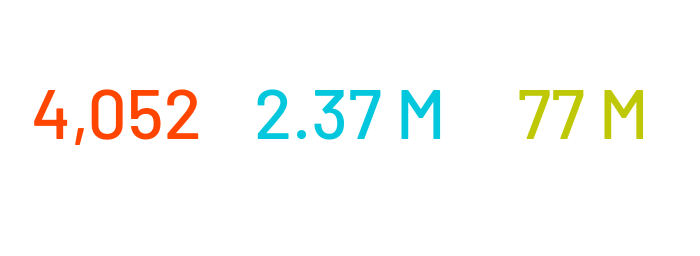
For statistical accuracy, our analysis includes only those organizations that received 10 or more whistleblowing reports in all of 2025. The resulting database includes 4,052 organizations that together received a total of 2.37 million individual reports. We also calculated metrics based on nearly 200,000 conflict of interest disclosures made through NAVEX One Disclosure Manager.
For each whistleblowing benchmark included in this report, you will find:
- A description of the benchmark
- Instructions to calculate the benchmark for your organization
- The 2025 combined data for all industries in the NAVEX database, with prior-year comparisons for legacy metrics
- Key findings and recommendations

Executive summary
Whistleblowing statistics and benchmarking data to help you navigate a changing compliance landscape
Trust remains one of the most critical assets an organization holds, and it is tested every day. It shapes culture, operational effectiveness, regulatory compliance and reputation. Internal reporting systems provide one of the clearest indicators of whether that trust is present – whether employees and third parties believe concerns will be heard and addressed without fear of retaliation.
This year’s Whistleblowing & Incident Management Benchmark Report reflects data from 4,052 organizations, representing approximately 77 million employees and 2.37 million reports received in 2025 – the largest dataset of its kind. In a period marked by economic uncertainty, workforce restructuring, geopolitical tension and accelerating adoption of artificial intelligence, internal reporting trends offer important insight into how organizations and their employees navigate these dynamics.
This report provides boards, executive leaders and compliance officers meaningful benchmarks for evaluating speak-up culture, investigative effectiveness and organizational responsiveness.
Key findings
Reporting volumes reached record levels with growing divergence across organizations
Median Reports per 100 Employees once again reached an all-time high. At 1.65 in 2025, reporting increased nearly 5% over the sustained record levels of the previous two years. This is particularly notable given that past periods of economic uncertainty often led to lower reporting levels due to fear of calling attention to oneself.
Fewer organizations are experiencing very low reporting activity, and more are receiving higher Reports per 100 employees. Reporting increased across nearly all organization sizes, with the largest enterprises remaining near five-year highs.
Organizations that track all intake channels – Web, Hotline and other sources – consistently report higher visibility into concerns. Monitoring all reporting avenues remains essential to understanding an organization’s full risk profile, particularly as increased reporting places greater demands on response systems.
Increased reporting lengthens case closure times
One of the most significant findings this year relates to Case Closure Time. The median increased by seven days year-over-year, from 21 to 28 days – a 33% increase. No organization size was immune, and nearly every Risk Type experienced longer investigation timelines.
Workplace Civility cases, which historically resolved more quickly, increased from 19 to 31 days. While the percentage of cases open for more than 100 days declined, cases closed within 10 days decreased significantly, signaling pressure on investigative systems.
Workforce reductions, economic pressures and increasing case complexity may be influencing timelines. Additionally, integration of AI-enabled tools may introduce additional review steps that enhance insight while extending duration. Regardless of cause, timely resolution remains essential to sustaining reporter confidence.
Reporting patterns reflect a shifting range of organizational risk
Workplace Conduct continues to represent the largest category of reports, with Workplace Civility remaining the most common Risk Type. However, overall Workplace Conduct reporting declined slightly in 2025.
Several Risk Types increased in both frequency and median reporting value, including Workplace Civility, Retaliation, Political Activity, Environment and Imminent Threat. These categories often require deeper fact-finding and may contribute to the longer investigation timelines observed this year.
Retaliation reporting remains particularly important for leadership to monitor. Although reporting increased, substantiation rates declined and median Case Closure Time rose from 32 to 35 days. Because retaliation concerns strongly influence whether employees feel safe speaking up, boards and executive leaders should continue to track this metric closely.
At the same time, financial and asset-related concerns moved closer to historical levels, suggesting reporting patterns are continuing to normalize following pandemic-era shifts.
Substantiation Rates ease but remain historically strong
After reaching an all-time high in 2024, the overall Substantiation Rate declined modestly to 44% in 2025 but remains within the mid-40% range that has characterized much of the post-pandemic period.
Nine of the 24 Risk Types had a Substantiation Rate over 50%, with Imminent Threat to a Person, Animals or Property most likely to be substantiated at 83%. Global Trade matters were substantiated at 56%.
None of the Workplace Conduct Risk Types reached 50%, though the category’s median Substantiation Rate has remained consistent over five years. Reports of retaliation were substantiated at 16%, significantly below the overall rate, reinforcing the need for careful oversight. As reporting volumes rise and case complexity increases, modest moderation in substantiation is not unexpected.
Corrective actions reflect more graduated responses
Outcome data suggests organizations are applying more deliberate and differentiated corrective actions. “No Action” outcomes for substantiated cases declined to a five-year low, while Training and Discipline increased and Employment Separation declined across several major Risk Categories.
These shifts point toward more graduated accountability. Rather than defaulting to termination, organizations appear to reinforce expectations through corrective training and documented discipline.
However, when corrective action is less visible than termination, organizations may need to reinforce through communication that concerns are taken seriously and addressed consistently. Consistency, proportionality and visibility in corrective action remain essential to maintaining confidence in speak-up systems as reporting volumes and investigative complexity grow.
Reporting channels continue to evolve
Web reporting continues to exceed Hotline reporting by frequency. Employee Hotline usage declined over a three-year period, while Web intake increased. Reports submitted through Other channels rose modestly.
Organizations that track intake across all available sources report significantly higher median reporting levels than those that track only limited channels, reinforcing that visibility drives insight.
Web reports remain more likely to be anonymous yet continue to demonstrate strong substantiation rates. Follow-up engagement with anonymous reporters reached a five-year high, showing that anonymity does not prevent meaningful dialogue. As reporting behaviors shift, organizations should ensure all channels remain accessible, well-publicized and integrated within a unified case management framework.
Third-party reporting is a distinct and important risk signal
Third-party reporting represented approximately 10% of identified reporter relationships in 2025 and provides important external visibility into business integrity and financial risk.
Third parties submit a disproportionately high share of Accounting, Auditing & Financial Reporting and Business Integrity concerns compared to employees. Anonymity among third-party reporters remained lower than among employees, and the share of third-party reports resulting in “No Action” has steadily declined.
Maintaining accessible and credible reporting avenues for external stakeholders is essential, as their unique perspective can surface risks not visible internally.
The “Other” category signals emerging and under-classified risks
The “Other” Risk Category revealed notable shifts in 2025. Case Closure Time increased substantially, Separation more than doubled year-over-year and Substantiation Rate increased, even as overall substantiation softened.
Reports classified as “Other” may represent emerging risks, ambiguous concerns or issues that sit at the intersection of culture and compliance. When a catch-all category begins to demonstrate higher substantiation and more significant outcomes, it may signal cross-functional risks or inconsistencies in classification practices.
Organizations experiencing this pattern should evaluate whether developments within “Other” reflect evolving cultural or operational themes or opportunities to improve classification consistency and awareness.
Ownership structure influences reporting and response patterns
Ownership structure highlights meaningful differences in reporting behavior. Government entities reported the highest median reporting levels, while public companies reported the lowest. Private organizations demonstrated higher Substantiation Rates and higher frequencies of Employment Separation compared to public companies.
These differences likely reflect variations in regulatory oversight, stakeholder expectations and governance frameworks. Ownership does not determine program effectiveness, but it shapes how reporting and response patterns emerge. Benchmarking against similarly situated organizations is essential to ensure meaningful comparisons and accurate interpretation of trends.
Ownership analysis continues to highlight differences in reporting behavior. Government entities reported the highest median reporting levels, while public companies reported the lowest. Private organizations showed higher Substantiation Rates and higher frequencies of Employment Separation compared to public companies.
Conflict-of-interest disclosures also provide valuable insight
Conflict of interest disclosures provide a proactive lens into organizational culture. In 2025, median Disclosures per 100 Employees reached 3.8, with higher activity in the United States than in EMEA/APAC regions. Individual Contributors represented most disclosure activity.
Relationships and Outside Employment disclosures increased year-over-year, suggesting growing awareness of potential conflicts. Executives most frequently disclosed Board Positions and Outside Investments.
Unlike hotline reports, disclosures often reflect early transparency rather than alleged misconduct. Higher disclosure activity may indicate strong policy awareness and a culture in which employees are comfortable surfacing potential conflicts before they escalate.
Key actions
Tips and key takeaways to maximize your whistleblowing program
We encourage readers to browse this report for scores of additional whistleblowing statistics and key metrics that may have relevance for their organization. However, given our overall observations, we suggest a few key actions to consider – actions that in many ways are timeless examples of how to promote an effective internal reporting program.
Conclusion
See more in the full reportUse the latest whistleblowing statistics to inform and improve your program
It is always important to acknowledge that there are no “right” outcomes in benchmarking data. Each organization faces a unique operating environment and culture. Our enduring hope is that these whistleblowing statistics and key metrics provide context for organizations seeking to improve – to provide reporters a means to raise concerns of misconduct without fear of Retaliation, and to form the basis of a culture of ethics and compliance.
Meet the authors

Carrie Penman
Chief Risk & Compliance Officer
NAVEX

Eric Gneckow
Senior Content Marketing Manager
NAVEX

Linda Meikle
Associate Director, Content Marketing
NAVEX

Isabella Oakes
Data Scientist Specialist
NAVEX

Anders Olson
Senior Manager, Data Science
NAVEX
Related resources

eBooks
Top 10 Risk & Compliance Trends for 2026
Stay ahead of AI regulation, cultural pressure, and global governance change with insights that prepare you for what’s next.
Get the eBook

Webinars On-Demand
The 2025 State of Risk & Compliance: Program Benchmarking, Barriers & Tech-Driven Insights
Get a data-driven look into the evolving landscape of risk and compliance in 2025. Learn how leading organizations are benchmarking program maturity, adopting AI and compliance tech, and breaking down operational and regulatory barriers to stay ahead.
View on demand

Guides
Definitive Guide to Incident Management
This definitive guide is a comprehensive resource full of tips, advice and examples to help your organization implement and manage an effective ethics and compliance intake and reporting program.
Get the guide